A bathroom mirror with lights brings illumination into the mirror design, but the description alone does not confirm a demister, adjustable brightness or the way its switches operate. An illuminated bathroom mirror can match the required shape and finish yet behave differently from the sample a buyer expected.
The light may use one control, the demister another, and a wall switch may change what happens when power returns. Before ordering for a UK wholesale range or an own-brand collection, agree these functions as clearly as the dimensions and finish.
For UK bathroom importers, wholesale distributors and own-brand suppliers, these details belong in the purchasing specification. They affect the sample review, product description, installation information and the questions a customer may later ask your after-sales team.
Use the following checklist to turn broad feature labels into a configuration that your supplier and sales team can describe consistently.
1. Choose between a bathroom mirror and a mirror cabinet with lights
Before comparing controls, decide whether the range needs a standalone mirror or storage behind mirrored doors.
A bathroom mirror cabinet with lights adds a storage requirement to the brief. Buyers should confirm cabinet depth, internal layout, door movement, fixing requirements and access for cleaning or service. Check the proposed arrangement against the basin, taps and surrounding fittings.
If storage is not part of the brief, focus on the mirror’s dimensions, finish, lighting and controls. You can explore the AoTi mirror cabinet collection separately; the lighting, demister and other functions still need confirmation for the selected design.
2. Separate the lighting layout from the control specification
Front lighting, backlighting and an illuminated frame describe where light appears. They do not confirm how a mirror is switched, whether brightness can be adjusted, or whether a heated demister is included.
Start with the required width and height in millimetres, orientation, frame finish and lighting layout. Ask for a drawing that identifies fixing positions and the space needed around the proposed controls. Check the design against the intended vanity arrangement, then list each function separately. Our front-lit and backlit mirror guide explains the layout comparison; this checklist focuses on how the selected configuration operates.
For every proposed SKU, identify which features are included, which are optional and which are unavailable. Keep unconfirmed options out of the customer-facing product description.
3. Ask exactly how the demister operates
“Demister mirror” is not a complete operating specification. Ask the supplier to describe the proposed heated area and control arrangement for the selected design.
Resolve these questions before approving the sample:
- Is a demister included in this exact configuration?
- What are the heated area’s dimensions and position behind the mirror, in millimetres?
- Does it operate with the light, independently, or through another agreed control?
- Is there an automatic shut-off, and what is its stated behaviour?
- How does the user know whether it is operating?
- What behaviour should the instructions describe after power is interrupted?
Do not promise that the entire surface will remain clear in every bathroom condition. Ask for the proposed performance statement and the conditions under which the sample should be assessed.
UK supplier documentation illustrates why these questions need separate answers. HiB’s Ambience Pill technical sheet addresses heated-pad operation alongside its lighting controls. Roper Rhodes describes a separate demist function on its Calibre Oval mirror. Those are specifications for those particular products, rather than a universal rule for illuminated mirrors.
4. Write down the lighting and switch behaviour
A feature list should explain what a person actually does to operate the mirror. Request the control positions and an operating description, rather than approving a collection of icons alone.
| Area to confirm | Purchasing question |
|---|---|
| On/off control | Which switch or sensor operates the light? |
| Brightness | Is adjustment available on this configuration, and how is it operated? |
| Colour temperature | Is the light fixed or selectable, and which settings are agreed? |
| Memory | Which settings, if any, are retained after power is removed? |
| Demisting | Is its operation linked to the lighting or controlled separately? |
| Indicators | What remains visible when the main light is off? |
| Installation clearance | What clearance does the specified control arrangement require? |
If the customer expects the mirror to work with a room switch or a particular control system, state that requirement in the enquiry. Do not assume compatibility with an external dimmer or other controls unless the supplier confirms it for the supplied configuration.
5. Approve the sample against a short test record
Use an agreed sequence during sample review. Switch the light on and off, select the available settings, operate the demister as instructed, and check the agreed behaviour after power is restored.
Record what was supplied and what was observed. Where a function is missing or behaves differently from the brief, resolve the specification before ordering the bulk quantity.
For a demisting assessment, agree the conditions and acceptance criteria with the supplier. A quick showroom demonstration should not become an unsupported claim that the complete mirror stays clear in every installation.
Keep the approved sample reference, drawing revision and operating instructions with the purchase record. This gives the supplier, your product team and after-sales staff the same reference for repeat orders.
6. Start with an AoTi design reference
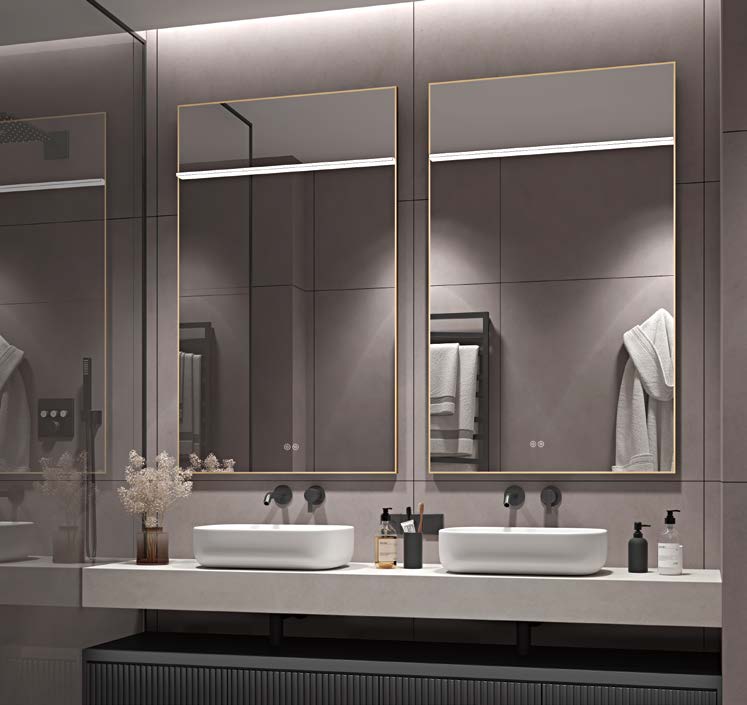
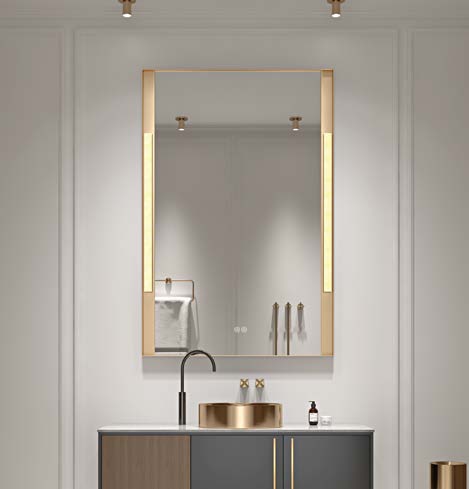
The AoTi stainless steel mirror collection includes different lighting layouts that can start a specification discussion.
The JB015B design on this product page is described with a 304 stainless steel frame, silver mirror and acrylic, with an illuminated upper acrylic section. The JB020B page describes a 304 stainless steel frame and silver mirror, with decorative front lighting on both sides.
Their published pages leave dimensions and functions for confirmation. They do not establish a standard demister, dimming function, colour-temperature setting or electrical rating for every order.
Send the exact product link, required width and height in millimetres, finish reference and proposed functions. Ask AoTi Mirrors to confirm feasibility and the written configuration before requesting a matching sample.
7. Keep documents and labels aligned with the supplied version
For applicable electrical equipment supplied into Great Britain, the current GOV.UK guidance addresses technical documentation, conformity assessment, product identification and English instructions. Northern Ireland has a separate guidance route.
Ask the responsible importer or compliance adviser to identify the requirements for the exact product, destination and supply arrangement. Match the documents to the finished configuration, including any changes made for an own-brand order.
An attractive photograph or a component approval does not settle the finished mirror’s documentation. Any stated IP rating, connection arrangement or installation suitability should be supported for the selected product and reviewed by the appropriate project team.
8. Prepare for damage reports and replacement enquiries
For a wholesale range, agree how each carton and product can be traced to the correct version. A product code should allow your team to identify its dimensions, finish, lighting and controls without relying on the original sales photograph.
Discuss packaging for the planned shipping and distribution route, including protection for glass, edges and any projecting controls. Agree how to report damage, what photographs or batch details are needed, and how replacement cases will be handled. Avoid claiming a packaging test has been passed unless evidence is available.
Also ask about the proposed service procedure, available replacement parts, warranty terms and any access required for service. Do not promise that a driver, switch or heated pad can be replaced independently until the construction and service instructions are confirmed.
For own-brand buyers, include the approved operating instructions and feature wording in the artwork review. Accurate product descriptions help prevent a customer expecting functions that were never ordered.
Frequently asked questions
Does a bathroom mirror with lights also include a demister?
No inclusion should be assumed from the term “illuminated”. Confirm the feature list for the exact model and configuration, then check the sample and instructions against it.
What is the difference between an illuminated mirror and a demister mirror?
Illuminated describes a mirror with lighting; demister describes a function intended to reduce mist on a specified area. They are separate features, and a proposed product may combine them. Confirm both against the exact ordering specification.
Should the demister work independently from the light?
That depends on the intended range or project brief. Ask which arrangements are available and select the required behaviour in writing. Do not treat one supplier’s control arrangement as a standard for every product.
Can we use the mirror with a wall dimmer?
Ask for confirmation of the exact proposed combination. An integrated brightness control does not, by itself, establish compatibility with an external wall dimmer.
Should we choose a bathroom mirror or a mirror cabinet with lights?
Start with the storage requirement and the intended bathroom layout. If specifying a cabinet, agree its depth, door clearance, internal layout and fixing requirements as well as the lighting and control functions. Confirm the actual configuration before including it in a wholesale range.
What information is needed for an own-brand quotation?
Provide the product reference, dimensions in millimetres, finish, quantity, destination, required lighting and demister behaviour, packaging and artwork brief. Add the documentation and after-sales arrangements your business needs.
Are hotel makeup mirrors covered by the same specification?
They need their own selection record. For magnification, arm movement and hotel fitting considerations, see the UK hotel makeup mirror trade guide.
Build a clearer brief for your next trade order
Send AoTi Mirrors your selected product links, quantities and delivery destination, together with the dimensions, finish and control behaviour you need. We can discuss the available configuration and the details to confirm for sampling and quotation.
Use our Trade & Project Supply page to organise the wider brief, including packaging, documentation and order requirements.
Email: [email protected]
WhatsApp / WeChat: +86 15914555118
Factory Address: Shangbai Industrial Zone, Luocun, Nanhai District, Foshan, Guangdong, China